Every parent I sit with starts the same way — with a question. Not "Can you adjust my kid?" but something closer to "What exactly does a pediatric chiropractor do?"
It's a fair question. The word "chiropractor" carries a lot of assumptions, most of them built around adult spines and loud cracking sounds. So when someone says "pediatric chiropractor," the picture gets muddy. You might imagine a tiny version of an adult appointment, scaled down to kid-size. But that's not what this is — not even close.
A pediatric chiropractor works with a child's nervous system. That's the short answer. The longer answer is about what that actually means in practice, and why it matters more than most people realize.
It Starts With the Nervous System, Not the Spine
When a child comes into my office, I'm not looking for a bone out of place. I'm looking at how well their nervous system is adapting — how well it's receiving information from the world, processing it, and responding.
Think of the nervous system as the communication network of the body. Every sensation, every movement, every emotional reaction passes through it. When that system is working well, a child can settle, focus, sleep, grow, and recover from stress without getting stuck. When it's not, you see it in ways that don't always look "chiropractic" on the surface — colic, sleep struggles, sensory overwhelm, frequent meltdowns, delayed milestones, recurring ear infections.
The spine matters because it's the structural home of that system. Tension or restriction in the spine affects how clearly nerve signals travel. But the spine is the doorway, not the destination. What I'm actually doing is helping a child's nervous system function with less interference.
What an Adjustment Looks Like for a Child
If you've never seen a pediatric adjustment, here's what I want you to know: it is nothing like an adult adjustment.
For an infant, the pressure I use is about what you'd use to check the ripeness of a tomato. For a toddler, it might involve sustained contact and a lot of patience while they wiggle around my office. For a school-age child, the work might include movement-based assessments, breathing, and specific contacts that help their body release tension patterns it's been holding.
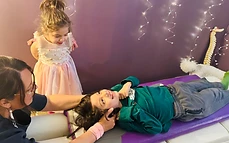
There's no forcing. There's no cracking. The work is specific, light, and responsive to what each child's system needs on that particular day. Some kids lie still. Some kids climb on me while I work. Both are fine.
I assess how a child moves, how they hold tension, how their primitive reflexes are integrating, and how their autonomic nervous system is shifting between "ready" and "rest." The adjustment itself is one piece of a bigger picture — one that includes what's happening at home, at school, in their sleep, and in their body's story from birth onward.
Why Families Actually Come In
The reasons families bring their children to see me are as varied as the kids themselves. Some come because their baby isn't sleeping and nothing else has helped. Some come because their toddler falls apart every afternoon when they get home from preschool, and they can feel in their gut that something is off. Some come because their school-age child is anxious, or because their teenager has headaches that no one can explain.
I've worked with infants who were born after long, difficult labors — their bodies holding patterns of tension from the birth process itself. I've worked with kids who seem to be hitting every milestone but whose parents notice they're always wired, always braced, never fully settling. I've worked with children navigating sensory processing differences, where the world feels like too much input and not enough filter.
What ties all of these together isn't a specific diagnosis. It's a recognition that the nervous system is the common thread — and when you support it, children often change in ways that surprise their parents. If your child is struggling with emotional regulation or sensory overwhelm, that connection is worth understanding.
What a Pediatric Chiropractor Does (and Doesn't)
I think it's worth being direct about this: I'm not treating diseases. I'm not replacing your pediatrician. I'm not promising that chiropractic care will cure your child's anxiety, eliminate their ear infections, or fix their sleep overnight.
What I am doing is removing interference from a system that was designed to heal, regulate, and adapt on its own. When that system works better, the rest often follows. Sometimes that looks like a child who finally sleeps through the night. Sometimes it looks like a kid who can handle a transition without melting down. Sometimes it's subtler — a parent telling me, "I don't know how to describe it, but she just seems more like herself."
That's the work. It's not flashy. It's not a quick fix. It's consistent, specific care that helps a child's body do what it was built to do.
Want to learn more? Book a free consultation.
How We Get Started
If you're reading this and thinking, "This might be what my child needs," the first step is a conversation. Not an adjustment — a conversation. I want to understand what you're seeing at home, what your child's birth and developmental history looks like, and what you're hoping for.
From there, we do a thorough assessment — checking how your child moves, how their nervous system is functioning, and where there might be patterns of tension or interference. Then I walk you through what I'm finding, what I'd recommend, and what that would look like going forward.
No pressure. No sales pitch. Just a clear picture of what's going on and whether this is the right fit for your family.
You can learn more about how we work with kids on our pediatric chiropractic care page, or reach out directly to schedule that first conversation.
Dr. Alexandra Swenson-Ridley is a pediatric and family chiropractor at Life Sprout Collective in Fairbanks, Alaska. She works with children from infancy through adolescence, supporting nervous system health, developmental milestones, and family wellness.


ICPA certified pediatric chiropractor, Webster Technique certified, and National Board Certified Health & Wellness Coach serving Fairbanks families.
More about Dr. Alex