You've watched your child sit at the kitchen table with homework that should take twenty minutes, and an hour later they're on their third pencil, staring at the ceiling fan, tapping their foot, getting up for water, sitting back down, and starting a sentence they never finish.
You've asked them to put their shoes on, and ten minutes later they're in their room, holding one sock, looking at a Lego piece they found on the floor. It's not defiance. You know that. But it's exhausting — for them and for you — and at some point you start wondering whether something deeper is going on.
Here's what I want you to know before we go any further: I'm not going to tell you chiropractic is a fix for attention challenges. What I can tell you is that focus isn't only a brain thing. It's a nervous system thing. And when a child's nervous system is stuck in overdrive — running a low-grade survival program even when there's no actual threat — the part of the brain responsible for attention, organization, and emotional regulation can't do its job well.
Pediatric chiropractic care works with that. Not by treating a diagnosis, but by helping the nervous system shift out of the state that makes focusing so hard.
What Focus Actually Requires
Focus is a regulated state. To pay attention to something — a worksheet, a conversation, a set of instructions — your child's nervous system needs to be in what's called a ventral vagal state. This is the branch of the nervous system associated with safety, social engagement, and the ability to be present.
When a child's nervous system is stuck in sympathetic arousal — the fight-or-flight branch — their body is prioritizing survival. Blood flow shifts away from the prefrontal cortex, where planning, impulse control, and attention live, and toward the muscles and systems that would help them run or fight. This isn't a flaw. It's an adaptive response. But when it becomes chronic, when the nervous system never fully comes back to baseline, focusing becomes physiologically difficult.
This is why some kids can focus beautifully on things that are novel or high-interest — a video game, a favorite show, a new toy — but fall apart the moment the task is sustained, boring, or emotionally loaded. Their nervous system isn't stuck in overdrive all the time. It's stuck in a pattern of going there easily and coming back slowly.
Where Pediatric Chiropractic Fits
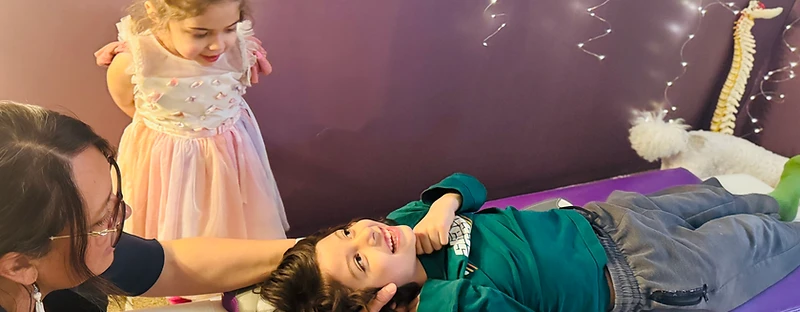
Pediatric chiropractic adjustments work directly with the nervous system. When I adjust a child, I'm looking for areas where tension, restriction, or misalignment in the spine and pelvis are creating irritation in the nervous system — places where the body is holding stress that doesn't need to be held.
Think of it this way: if your child's nervous system is a radio, and it's tuned to a static-filled station, adding more strategies — a timer, a reward chart, a sticker system — is like turning up the volume. The static gets louder too. What chiropractic does is help clear the static. It doesn't replace the strategies. It makes the strategies work better because the nervous system is actually available to engage with them.
Many parents tell me that after a few visits, their child seems more settled. Not in a sedated way — in the way a person settles when they finally stop bracing. They make eye contact more easily. They transition between activities with less friction. They sleep better, and the sleep matters more than any supplement you could buy.
What This Doesn't Mean
I want to be clear about what this is and what it isn't.
Pediatric chiropractic is not a treatment for ADHD, and I won't pretend it is. If your child has a diagnosis, chiropractic care can be a powerful part of a broader support system — alongside therapy, educational accommodations, nutrition, and in some cases medication. It doesn't replace any of those things, and it doesn't compete with them.
What it does is address a layer that often gets missed: the physical and neurological state of the child's body. So many kids who struggle with focus are also carrying tension patterns that started at birth or accumulated through falls, growth spurts, and the daily demands of being a small person in a fast-moving world. When you address those patterns, you remove a source of interference that was making everything else harder.
What It Looks Like in Practice
The first visit is a conversation. I want to hear about your child — not just the focus challenges, but how they sleep, how they eat, how they handle transitions, whether they were a colicky baby, whether they've had ear infections, how they were born. All of it matters because the nervous system is one interconnected system, not a collection of separate parts.
The assessment is gentle and thorough. I check spinal mobility, muscle tone, reflexes, and how the nervous system is responding to its environment. Most kids find it interesting rather than uncomfortable — it feels more like being checked at a well-visit than anything they'd be nervous about.
Adjustments for children are nothing like adult adjustments. They're specific, light, and often use no more pressure than you'd use to check the ripeness of an avocado. The goal is always to give the nervous system a clear signal, not to force it into anything.
A Different Starting Point
If your child is struggling with focus, the most common starting point is to try to change the behavior — more structure, more reminders, more consequences. Sometimes that helps. But often, the child already knows what they're supposed to be doing. The problem isn't knowledge or willpower. The problem is that their nervous system isn't in a state where focus is available.
When you start by supporting the nervous system itself — helping it come out of survival mode and into a state where attention and regulation are possible — everything else gets a little easier. Not perfect. Not overnight. But easier.
Want to learn more? Book a free consultation and we'll talk about what's going on with your child and whether pediatric chiropractic care might be part of the picture. You can also learn more about our approach to pediatric chiropractic care or how we work with kids' emotional wellbeing.
Dr. Alexandra Swenson-Ridley is a pediatric and family chiropractor at Life Sprout Collective in Fairbanks, Alaska. She works with kids and families through a nervous system-centered approach, combining gentle chiropractic care with HeartMath and regulation tools.


ICPA certified pediatric chiropractor, Webster Technique certified, and National Board Certified Health & Wellness Coach serving Fairbanks families.
More about Dr. Alex